

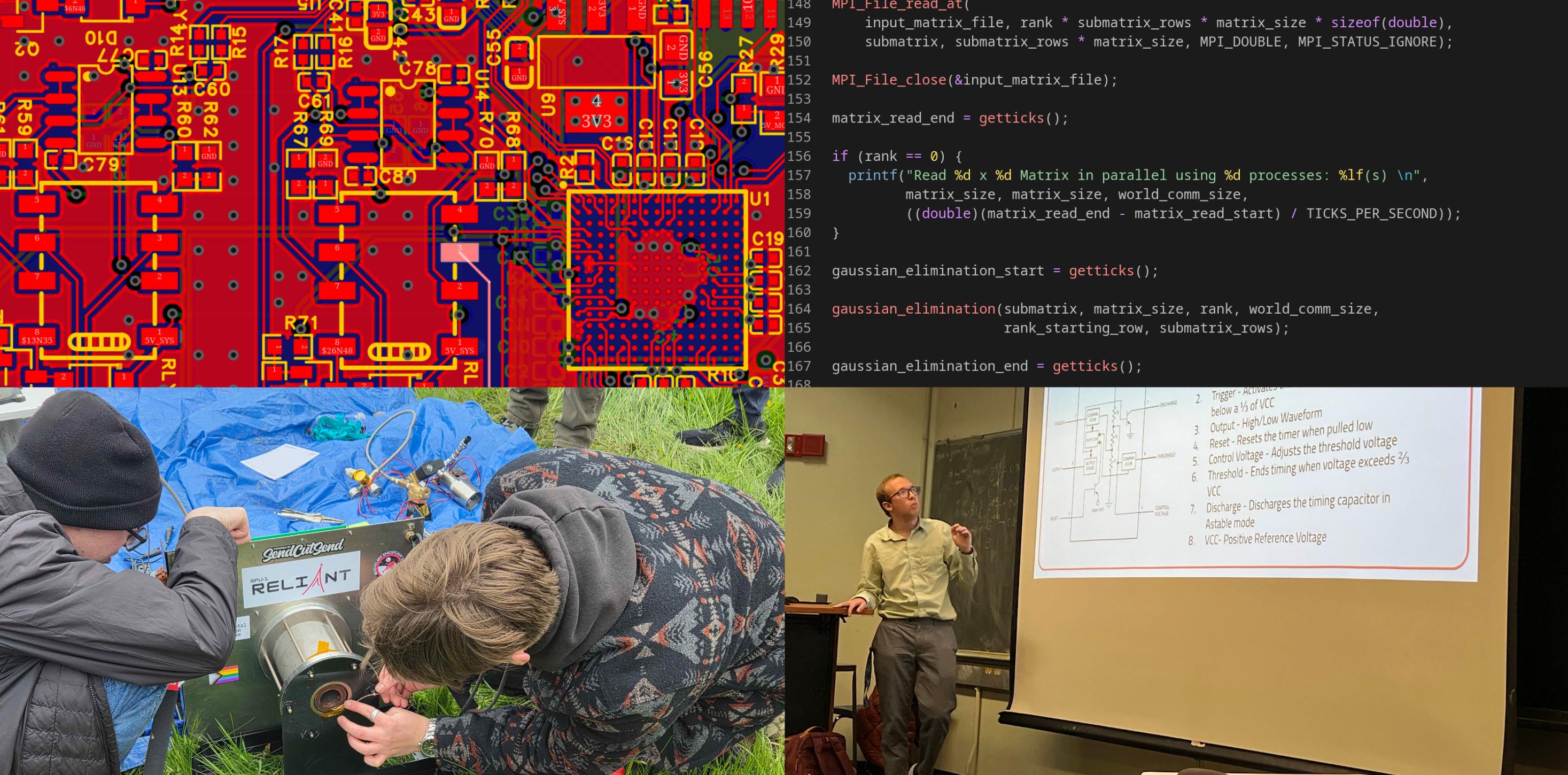
It’s Nice To Meet You, My Name Is:
I am a Hardware Engineer, Software Engineer, and lifelong learner with a strong work ethic, an unyielding attention to detail, and a passion for designing the next generation of computing technology.
I've worked across the full stack, from PCB design and embedded firmware to userspace applications.
I'm currently looking for roles in integrated circuit design, PCB design, or embedded systems engineering.

From when I first learned to code at 8, to installing Linux for the first time at 14, to teaching printed circuit board (PCB) design at 20, I have always been passionate about computing and its applications in aerospace, medicine, research, and entertainment. I am currently pursuing my Master of Science in Electrical Engineering with a concentration in microprocessors and computer hardware design. I am looking to contribute to making more powerful and efficient computing equipment.
M.S Electrical Engineering, Concentration: Microprocessors and Computer Hardware Design
Rensselaer Polytechnic Institute, Anticipated: May 2027
B.S. Computer Science, Concentration: Systems & Software
Rensselaer Polytechnic Institute, Graduated May 2026
May 2026 - July 2026
Metrology Software Engineering Intern
This summer I was responsible for setting up and characterizing a new laser spectrum analyzer (LSA) for an advanced metrology development program with stringent requirements for precision and accuracy.
Lessons Learned: How to apply statistics and data analysis to identify, isolate, and eliminate sources of error in both the equipment being tested and the test setup itself.
Nov. 2025 - May 2026
Freelance Hardware Design Engineer
I was responsible for the printed circuit board (PCB) design for some prototypes for a new product line. I used KiCAD to design multiple four-layer PCBs utilizing STM32H7 microcontrollers, professional-grade audio analog-to-digital converters (ADCs) and 100BASE-T Ethernet connectivity with Power Over Ethernet (PoE) support.
Lessons Learned: The typical application section on a datasheet is a typical application, but that's not necessarily your application. Datasheets have lots of information to help you but it can only help you if you read it rather than make assumptions based on the typical application.
June 2025 - Aug. 2025
Metrology Software Engineering Intern
I worked on a number of smaller tasks for a couple different development projects relating to the interferometers used in measuring optics during fabrication.
Lessons Learned: How optics are fabricated for applications like semiconductor manufacturing, and how to present technical work to non-technical audiences without understating it.
Apr. 2024 - Sep. 2024
Software Engineering Intern
I worked on developing image processing and machine learning algorithms for detecting lung cancer hotspots in CT scan data.
Lessons Learned: Writing software for medicine requires a strong attention to detail. When you remove that attention to detail, big problems can arise very quickly.
Aug. 2022 - Aug. 2023, after school + full time in summer
Software Engineering Intern
At TechSlice I worked on a little bit of everything from AWS resource management to front-end web design and development.
Lessons Learned: Classes, Interfaces, and abstractions exist for a reason. Using them creates cleaner, more maintainable code that can stay in production for longer.
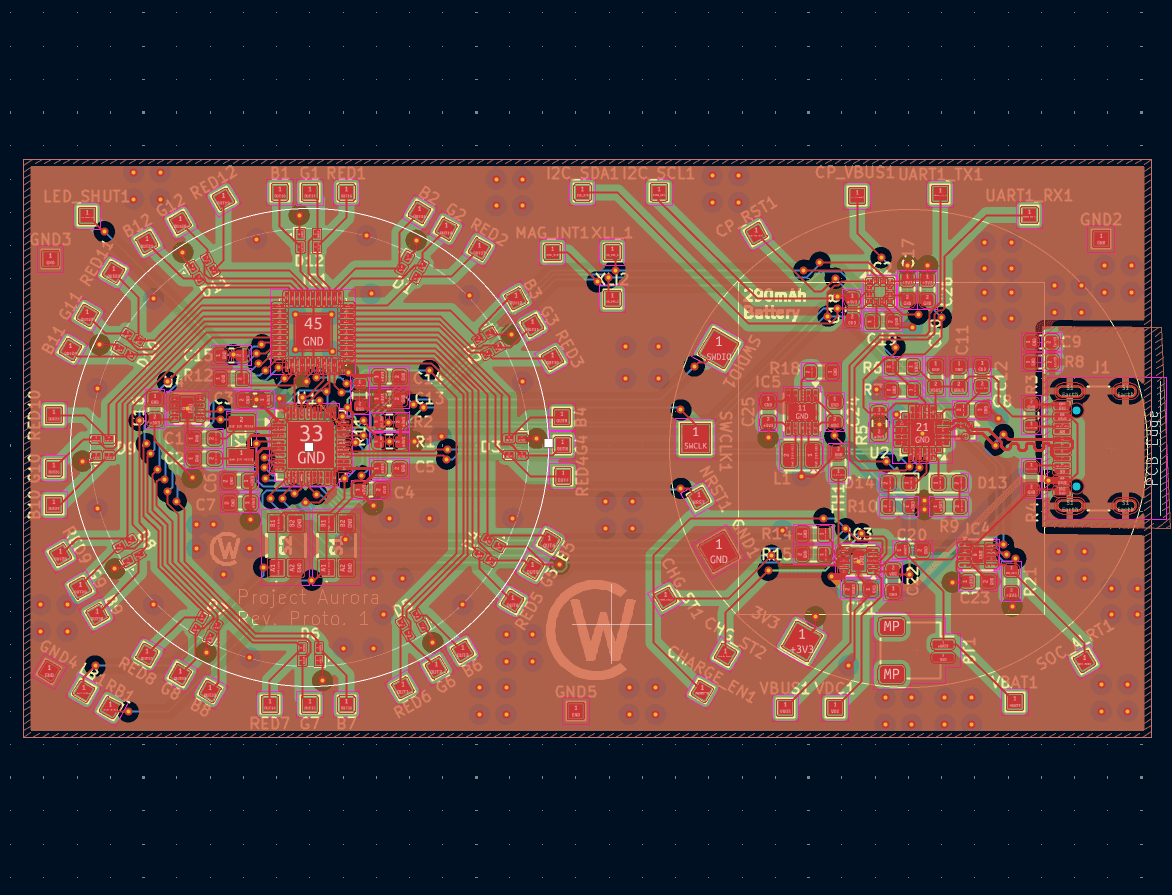
Project Aurora Prototype Board Schematic
Project Aurora is a custom smartwatch that I designed from scratch. The watch face is a printed circuit board with a ring of 12 RGB LEDs and two buttons. The time is displayed using the ring of LEDs, with red for the hour hand, green for the minute hand, and blue for the second hand. Aside from just keeping time, Aurora is a compass, a thermometer, a step counter, and a flashlight, all on your wrist.
Challenges Faced and Lessons Learned: On the first hardware prototype I only included test pads for connecting a debugger. Having to solder debug probe wires to the prototype resulted in significant signal degradation issues preventing the debugger from connecting to the MCU. I learned that for prototyping future projects, development boards should always trade size for a proper debug header.
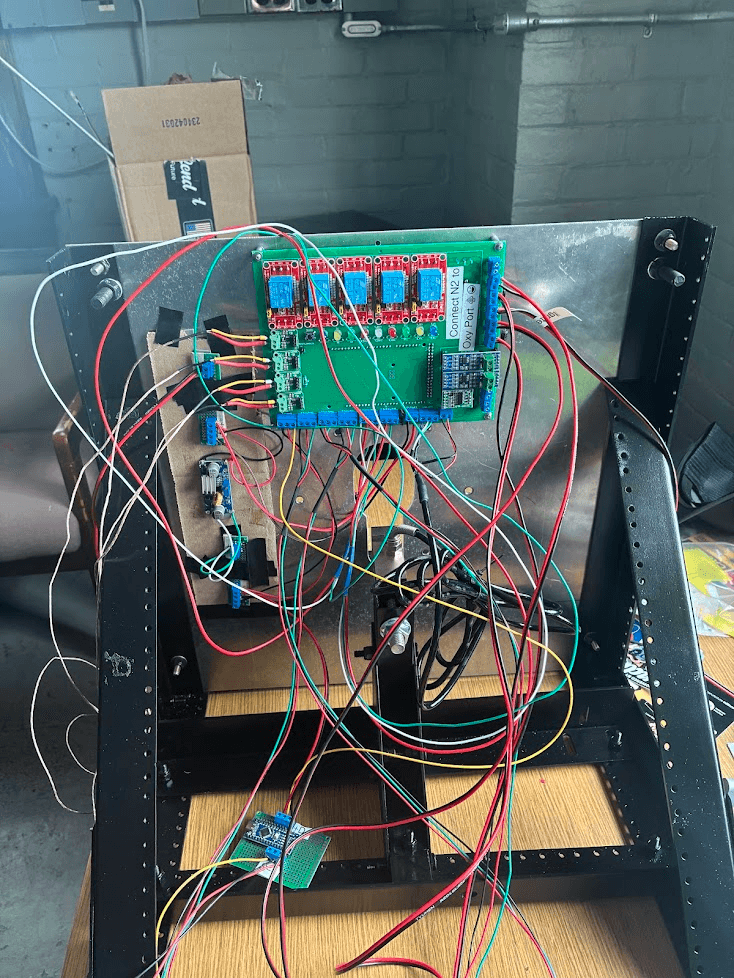
Electronics for RPU-1 mounted on the test stand.
Rensselaer Propulsion Unit 1 (RPU-1), nicknamed 'Reliant,' is RPI's first liquid fueled rocket engine, built entirely by RPI students as a part of the Rensselaer Spaceflight Society. This project is an interdisciplinary engineering project involving mechanical, aerospace, and electrical engineers, computer scientists, and physicists. I led electronics and software development for this project.
Challenges Faced and Lessons Learned: The solenoid valves we used to control fuel and oxidizer flow created highly inductive loads. This created transient voltages that damaged electronics. We learned lessons in component selection and the importance of transient voltage suppression diodes. We solved these challenges in RPU-2 by utilizing servo motors to create our own infinitely adjustable valves.
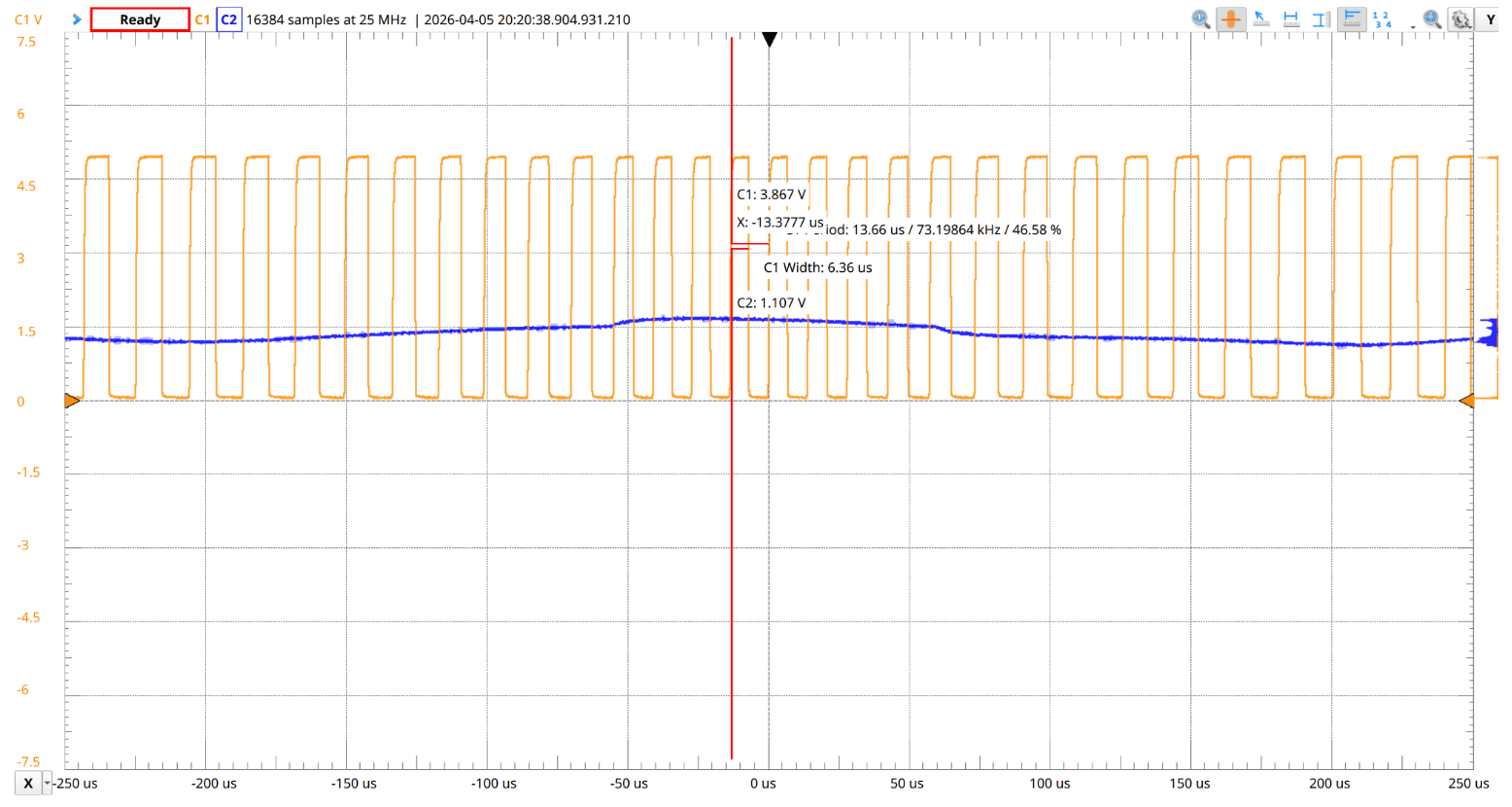
Scope reading demonstrating how the transmitted frequency changes as the input voltage does.
I built this project alongside my classmate, Zakki Suhu, as part of my ECSE-2010 Electric Circuits class. However, we were given no guidance on how to design or build the circuit. Our goal was to take audio from a small microphone, convert it to an FM radio signal, and then receive it on another breadboard, demodulate the signal and play it through a speaker.
Challenges Faced and Lessons Learned: We assembled our circuit on a breadboard which meant that we were forced to use components that could be inserted into a breadboard. Our limited options for parts meant that our carrier frequency was very low and our antenna was likely too short. This meant we were unable to get the radio transmission part working. We learned the importance of thorough part selection and the limitations of breadboard electronics.
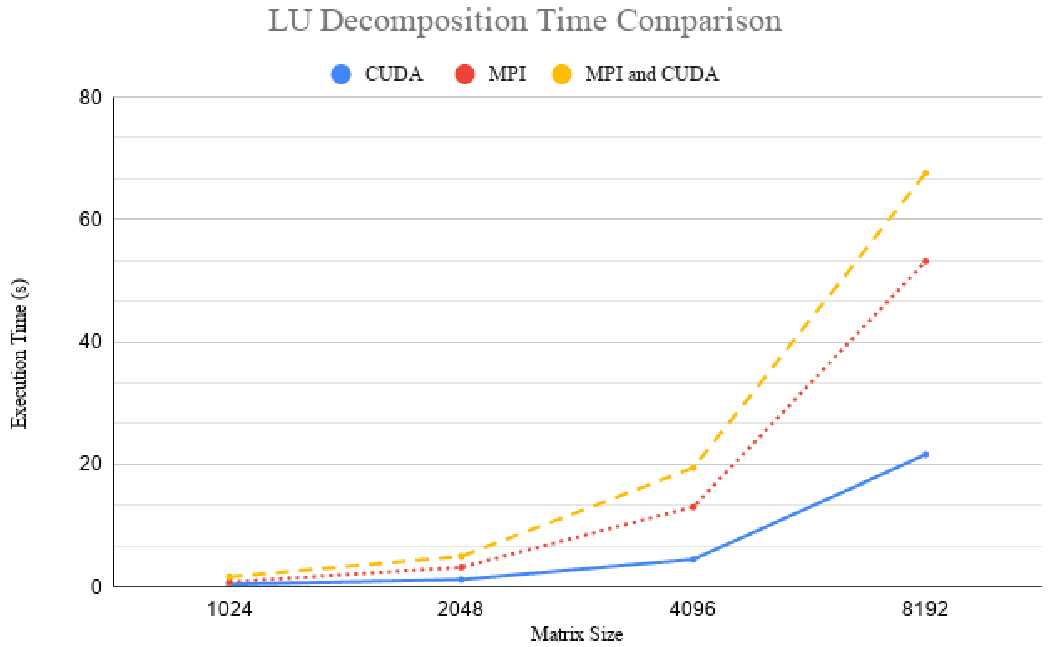
LU decomposition scaling performance plots
This project was a paper that my friend Xenia Khusid and I wrote for our final project in CSCI-4320 Parallel Computing and Programming. We implemented four different methods for performing LU decomposition on dense random matrices. We ran each implementation on RPI's AiMOS supercomputer, performing a study analyzing the scaling performance of each implementation. We found that for matrices that could fit on a single GPU, the CUDA only approach was the fastest method.
Challenges Faced and Lessons Learned: Race conditions and memory safety bugs came up constantly. Our implementations were written in C and C++ as required for MPI and CUDA. The LU decomposition algorithm requires constant communication between MPI ranks, requiring careful control over memory. From this experience we learned a lot about memory management best practices and how to debug memory corruption bugs and race conditions.
Link to PaperInterested in working together? Just want to talk hardware? I’m always happy to connect.
Made with ❤️ by me!
© 2026 Cooper Werner. All rights reserved.